



WorldBox
Why does a peaceful elf kingdom suddenly declare war on its neighbors two minutes after you gave it a nice forest? WorldBox answers that question constantly, because every human, orc, elf and dwarf village you spawn develops its own culture, kings and grudges while you watch from above with a toolbox full of godly powers.
| Genre | God simulator sandbox |
|---|---|
| Races | Humans, Orcs, Elves, Dwarves |
| Powers | Terrain shaping, creatures, disasters, traits, blessings |
| Goal | No fixed goal, watch civilizations grow and collapse |
| Disasters | Meteors, tornadoes, earthquakes, plagues, nukes |
Shaping Land and Seeding Life in WorldBox
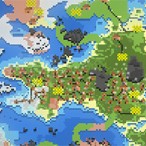
A new world starts as a blank map that you paint with land, mountains, forests and water. Once the terrain looks right, you drop a few people from one of the four main races and watch them build their first huts. Within minutes villages turn into towns, towns form kingdoms, and kingdoms start trading or fighting.
The races behave differently. Orcs tend to be aggressive, elves prefer forests, dwarves love the mountains and humans spread almost anywhere.
Beginners usually spawn too many races too close together, which leads to instant wars that wipe out half the map. Giving each race its own continent produces longer, more interesting histories, and many players enjoy placing islands and land bridges so kingdoms meet only after they have grown. Storytellers love following one family of kings for hundreds of years.
Kingdoms, Kings and Constant Drama
Every kingdom has a king, cities have leaders, and individual units carry traits like strong, wise or greedy. Those traits influence wars, rebellions and alliances, and the history log records who betrayed whom.
Clans and cultures appear as the world ages. Kingdoms split when rebellions succeed, and new ones rise from the ruins.
That emergent drama is the real hook. You can inspect any unit and follow their life, which makes even a small village feel full of stories. It is a much bigger version of the population pressure in ClanGen, and a fun contrast with Dummynation, where you control one nation directly instead of watching from above.
Disasters and Experiments Players Love in WorldBox
Sooner or later everyone tests the destructive powers. Meteors crater continents, tornadoes scatter villages, plagues sweep through cities, and the atomic bomb ends arguments very quickly.
The community treats these as experiments. A common challenge is protecting one small kingdom from everything the world throws at it.
Players do debate the balance of some races and the speed of late-game wars, which can drown out quieter stories. Still, the option to rebuild after any catastrophe keeps sessions fresh, and sandbox fans who want physics instead of politics can try Universe Sandbox 2 for the same god-like perspective on a cosmic scale.
Frequently Asked WorldBox Questions
Which race is strongest?
It depends on terrain and traits, but orcs often dominate early wars because of their aggression. Dwarves do well in mountainous worlds, while elves thrive when there is plenty of forest.
How do you stop constant wars?
Separate kingdoms with water or mountains, or use powers that calm units. Giving each race space to grow before contact leads to longer peace.
Can you control individual units?
You can inspect units, give them traits and change their kingdom through powers. Direct control of their movement is not the focus of the sandbox.
WorldBox gives you the land, the races and the disasters, and the joy comes from watching one small orc village turn into an empire with its own kings, grudges and history.