












Family Time
What happens when the cots run out before the night does? In Family Time that question decides almost every evening, because the Wolf Mama brings more wolf children into the house each night and expects every one of them to be sheltered, fed and tucked into a bed of their own by the time the lights go down. You play the father, and the family only ever gets bigger.
What Family Time Asks of a New Father
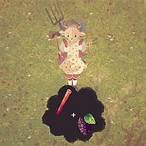
The setup is simple and a little absurd. A human father suddenly has dozens of wolf children to look after, and his partner, the Wolf Mama, has one rule that never bends: if the children are not provided for, she kills him. Everything you do in the first-person world around the house comes back to three jobs that never go away, which are shelter, food and sleep.
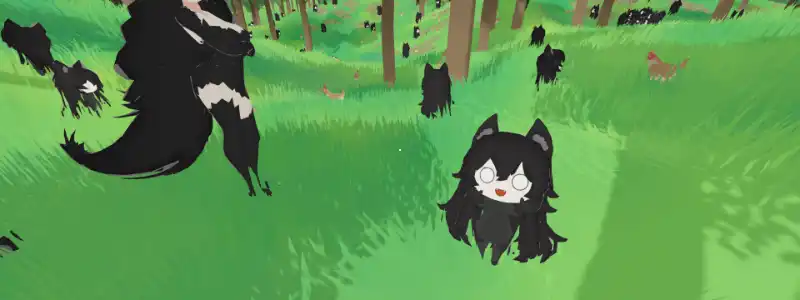
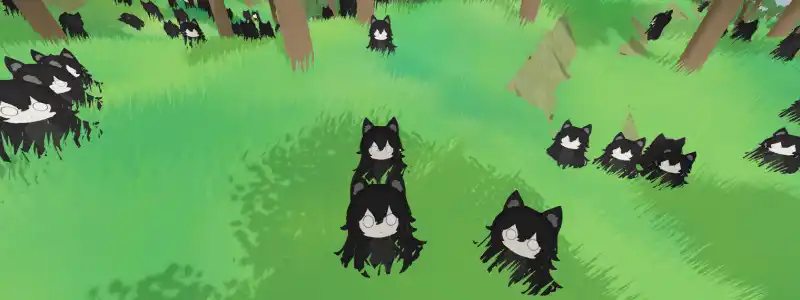
What makes the loop tense is the clock. Every night the litter grows, so a household that was perfectly fine yesterday can fall short tonight even if you did nothing wrong. The opening hours of Family Time feel cozy, with soft green fields and pups trotting after you, but the arithmetic underneath is merciless, and the community jokes that the real antagonist is a spreadsheet with wolf ears.
The answer the game gives you is delegation. You can chop, haul and build yourself, but the children can do all of that too once you learn to give orders, and by the time the family passes a hundred pups the father barely touches an axe. Colony sim fans will recognise the shift immediately: you stop being the labour and become the planner, choosing where the next house goes and which food source needs another team.
The world itself is gentle on the eyes. Rolling green hills, patches of forest, lakes and drifting fog surround the house, and wild chickens and pigs wander between the trees. The contrast between that peaceful countryside and the growing pressure inside the house is a big part of the charm, and it is why so many first sessions start with sightseeing and end in a panicked scramble for planks.
The challenge printed on the box says it all. Can you support ten children, a hundred, a thousand, ten thousand? Those numbers work like unofficial difficulty tiers, and completionists treat the last one as the obvious mountain to climb.
| Kind of experience | First-person colony sim with cozy family life |
|---|---|
| Where to play | Windows PC, single-player |
| What you do | Shelter, feed and command a family that grows every night |
| Who you meet | The Wolf Mama and her wolf pups |
| Where it happens | A green, foggy countryside with forests, lakes and wild animals |
| Structure | One open-ended survival mode delivered in episode builds |
Shelter First: Planks, Cots and the Mama's Bed
Shelter is the line that fails fastest, so it is where every good run starts. A tree chopped with the axe drops three or four logs, and hitting a log again splits it into planks. Nearly every structure costs exactly one unit of material per piece: a wall is one plank, a floor is one plank, a cot is one plank, and the Wolf Mama's bed is one log. That simplicity is deceptive, because a family of eighty needs eighty cots and enough floor to put them on.
Blueprints appear as blue previews you can walk straight through. They become real only when someone brings the right material and works on them with the mallet, which is why the first evening is mostly a loop between the forest and the build site.
The order most experienced players settle into for night one looks like this:
- Chop a couple of trees and split the logs into a small pile of planks.
- Flatten a patch of ground with the shovel so floors sit level.
- Place a small house: floor, walls and a roof.
- Fill it with cots for the children and one bed for the Wolf Mama.
- Count the pups again and compare the number with the cots before sleeping.
Beginners tend to get one thing wrong here. They explore first, find a lovely lake or a herd of pigs, and come back at dusk to a family with nowhere to sleep. The house in Family Time is not decoration; it is the score sheet the Wolf Mama checks, and building a row of plain little houses beats one beautiful cabin every time.
Terraforming is the quiet skill that separates tidy bases from messy ones. The left mouse button lowers or flattens ground with the shovel and the right mouse button raises it, so a large flat yard dug out on the first morning saves endless fiddling later. Builders love this part and happily spend a whole day laying out streets of cots and roofs.
Once the basics are covered, the building menu opens up in fun directions. Stairs and long roofs allow bigger houses, fences and swinging gates create pens, and chutes, ramps and funnels let tinkerers build little contraptions that slide planks to a site or carry water toward the houses. A sofa and a cauldron cost a boar tusk each, which gives pig hunts a second purpose beyond meat. None of these extras satisfy the Wolf Mama on their own, but they turn a survival camp into a home that feels lived in.
Feeding a Litter That Never Stops Growing
Food comes from hunting, farming, livestock and fishing, and the children eat meat on their own once an animal has been dealt with. Chickens are the friendly first meal: they are slow, the pups catch them quickly, and the father can carry three at a time. Pigs give far more meat but fight back, ramming anyone who gets close and fleeing in groups.
Catching a pig is one of those moments every player remembers. You grab it by the tail, steer it into a tree, and the thud knocks it out long enough for the pups to finish the job or for you to tie it with cords made from grass left to dry overnight. Pigs are too heavy for one person, so you call a handful of children to carry it home, and the sight of five tiny wolves hauling a boar across a field never gets old.
Hunting alone stops working once the family passes a few dozen. That is when pens come in, and the sooner the first fence goes up, the calmer the following week becomes.
A fenced pen with a wooden gate and a hay floor turns chickens into a steady supply: bring in hens and a rooster, feed them pumpkin seeds, and eggs start appearing on the hay. Pigs can breed too, though they want mud instead of hay and berries instead of seeds. Fishing adds a third source, with rods, buckets and bait such as meat, berries or acorns, and children assigned to work the lines. Players who like planning treat Family Time food like a portfolio, never trusting a single source to carry the night.
A practical split for a mid-sized family is one team on the chicken pen, one on fishing and a small hunting party that goes after pigs when meat runs low. Rotating those jobs is rarely necessary, since a team that does the same task every day settles into an efficient rhythm. The father then only steps in when a pen needs expanding or a new pond needs rods and buckets.
Water matters as much as meat. The children need to drink, so either walk them to a lake or build a well and let it overflow near the houses. A well costs a single boulder, and placing it next to the cots saves a surprising amount of walking once the family is large.
A few small details trip up almost everyone. Bowls come four to a plank and help keep meals organised, the cauldron speeds up turning grass into cord and opens the door to cooking, and children sometimes ignore food that is lying right in front of them. The usual culprit is locking: both the pups and the Wolf Mama need to be unlocked with a right-click, otherwise the children will not eat. Checking that once at the start of a run prevents a very confusing first night.
From Carrying Logs to Giving Orders
The pups are not just mouths to feed. They follow you around, carry logs and planks, work on blueprints, help with hunting and fishing, and pile into their cots when sent to sleep. A short sound cue plays whenever you send the Wolf Mama or the children somewhere, and after a few hours that little signal becomes the heartbeat of the whole household.
The trick is moving from doing to directing as early as possible. At a dozen children you can still handle jobs one group at a time, but at a hundred you think in teams: one crew on timber, one on construction, one on food. Placing the blueprint first and then sending the pack is far faster than carrying anything yourself.
The children also bring the softer side that made the whole thing go viral. You can pick them up for uppies, pat their heads, touch their fluffy ears and give them names, which helps you spot favourites in a crowd of near-identical black-haired wolf girls who all call you Papa. None of that keeps anyone alive, but cozy players will spend whole evenings naming pups instead of building, and nobody blames them.
The Wolf Mama is not just a judge standing in the corner. Over the development builds she gained new animations and sounds, awareness of what happens around her, visible anger, protective behaviour and even cheering when things go well. She reacts to the family, takes commands like the pups, and her mood is the clearest signal that something in the household needs attention. Learning to read her is as important as reading the pup count.
Heavy loads are a team effort. A long beam or a knocked-out pig needs several children carrying together, and three pups shuffling across the yard under one plank is one of the most shared clips from the community. Picking up one of the carriers mid-delivery confuses the group, so let them finish before scooping anyone up for uppies.
Scale is where Family Time gets genuinely impressive. The command system was rebuilt to handle thousands of children at once, and watching a field fill with pups carrying beams in every direction is a spectacle few colony sims can match.
Optimisers enjoy this stage the most. They measure how many planks a crew can move per day, place forests, stockpiles and build sites as close together as possible, and treat every new house as a logistics puzzle rather than a chore.
It is also where the rough edges show. Pups sometimes fail to find the target of a command, get stuck on uneven ground or end up trapped inside a fence they were helping to build. Flat yards, open gates and frequent saves solve most of it, but expect some herding.
Controls and Tools on the Item Bar
Everything runs on keyboard and mouse from a first-person view. The item bar at the bottom of the screen holds your tools and the blueprints you can place, and two keys handle most of the conversation with the children. Learning these in the first ten minutes makes every later night easier.
- Left mouse button: chop trees and split logs with the axe, lower or flatten ground with the shovel.
- Right mouse button: raise ground with the shovel.
- Mouse wheel: scroll through tools and blueprints on the item bar.
- F: call pups to follow you.
- E: order pups to carry logs and planks or work on a blueprint.
- F5: save the game.
- F6: load your last save.
Blueprints live on the same bar as the tools. Scroll to a wall, floor, cot or fence, place the blue preview where you want it, and then either carry materials there yourself with the mallet or call a group with F and send them in with E. Building from a stockpile of planks right next to the site keeps both you and the pups from wasting trips across the map.
Three tools do most of the work. The axe turns trees into logs and logs into planks, the mallet picks up materials and builds blueprint pieces, and the shovel reshapes the land. Animals and pups can be picked up directly, with chickens carried three at a time and pigs grabbed by the tail.
Two habits save a lot of grief in the pre-release builds. Save with F5 at the start of every day, and dig at a steady pace rather than spam-clicking the shovel, which players have found can crash the build. If a crowd of pups gets tangled, loading is quicker than sorting them out by hand.
On the technical side, the episode builds come in DirectX 12 and DirectX 11 versions. The DX12 build is the recommended choice, with DX11 as the fallback for older Windows machines, and the requirements are modest: a Windows 10 PC with 2 GB of memory and a graphics card in the class of an NVIDIA GTX 780 is enough to start a household.
How a Family Time Session Unfolds
There is one main mode: an open-ended household that runs until the family outgrows you. A tutorial prompt greets you on the first start, and from there the day and night cycle takes over. Mornings are for counting and planning, afternoons for building and food runs, and evenings for the final check before the Wolf Mama inspects the house.
The first in-game days are about survival in the most literal sense. You chop, build a single house, catch chickens and learn the keys. By the time the litter reaches a few dozen, the goal shifts to systems: pens that breed animals, a well beside the houses and teams of pups assigned to repeating jobs.
Later stages are about scale. Players who push far report families in the hundreds within a single long session, and at that point every decision is about placement and logistics rather than effort.
Failure follows its own rhythm. The community describes a three-strike rule: each night the family is not provided for angers the Wolf Mama, and the third time ends the run. Strikes stack rather than fade, so a great night does not erase a bad one. That makes Family Time feel closer to a countdown with cozy art than a relaxed farm sim, and players who expected a calm loop sometimes bounce off the pressure.
The game is still in development and arrives in episode builds, each adding systems such as chicken husbandry, pigs, fences and gates, an expanded Wolf Mama, furniture, water contraptions and pup naming. Some players hold back because placeholder art and early voices were made with AI tools during development and are being replaced with hand-made work and a professional voice actress. It is the most debated topic in every discussion thread, alongside requests for co-op and a choice of character.
A small modding scene already exists around the episode builds. A fan-made mod loader works with the current versions, and one popular mod makes pups notice when you carry a sibling and come asking for uppies of their own, with the Wolf Mama stepping in if you keep ignoring them. Mods are unofficial and can break with each update, but they show how attached players have become to these children.
The best routine for any session is the same morning check. Compare the number of cots with the number of pups, then compare food and water with tomorrow's appetite, and only then turn to furniture, fishing or new projects. Players who stick to that order rarely see the Wolf Mama lose her temper, while those who skip it learn about the three strikes the hard way.
Questions About the Wolf Family
What happens if you cannot look after all the wolf children in Family Time?
The Wolf Mama gets angry each night the family lacks shelter, food or beds. Players describe three strikes as the limit, after which she kills the father and the run ends, so keep cots and food slightly ahead of the headcount.
How do you make the pups build houses for you?
Place a blueprint, press F to call children to follow you, then press E to have them carry planks and logs into it. Once materials arrive, the pups work on the pieces until the structure is complete.
What is the best early food source?
Chickens, because they are slow and you can carry three at once. As soon as possible, build a fenced pen with a hay floor, add a rooster and feed pumpkin seeds so eggs keep the family fed without daily hunting.
Family Time takes a cozy household and turns it into a colony sim that never stops growing, and the runs that last are the ones where the father learns to trade his axe for orders, keeps a pen of chickens laying on the hay and makes sure every pup has a cot before the Wolf Mama comes to check.