






Universe Sandbox 2
What happens if you drop a second Moon next to Earth and speed up time? Universe Sandbox 2 lets you find out in seconds, because it is a physics-based space simulator where planets, stars and black holes follow gravity and collide in spectacular ways.
| Genre | Space physics sandbox |
|---|---|
| Objects | Planets, moons, stars, black holes, asteroids |
| Main tool | Adding, removing and changing celestial bodies |
| Simulation | Gravity, collisions, temperature, climate |
| Goal | Experiment and learn |
Bending Gravity in Universe Sandbox 2
You start with real systems like our Solar System and can change almost anything. Make the Sun heavier and watch orbits shrink, add a rogue planet and see it scatter moons, or move Earth closer to the Sun and watch the oceans boil.
The time control is the key tool. Speed it up to see orbits evolve over years, slow it down to watch a collision frame by frame, and pause whenever you want to inspect the mass, speed or temperature of any object.
Beginners often break the system immediately with a huge object, which is half the fun. Over time players learn to set up stable orbits and more subtle experiments. Students use it to understand gravity, while sandbox fans just enjoy the destruction.
Collisions, Black Holes and Climate
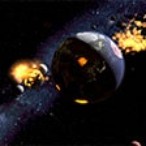
Collisions are the most popular experiments. Smashing planets together produces debris, molten surfaces and new moons.
Black holes swallow anything that gets too close. Watching a star get stretched and torn apart as it falls in is a classic moment that players record and share again and again.
Climate simulation adds another layer. Changing Earth's orbit or atmosphere affects temperature and ice. That cause-and-effect thinking is similar to playing god in WorldBox, though here the subjects are planets instead of kingdoms.
What Players Say About Universe Sandbox 2
Many players praise it as both a toy and a learning tool. The accuracy of the physics is a big draw, and seeing why the Moon stays in orbit or why a planet turns icy when pushed outward makes abstract science feel concrete.
Some find the interface complex at first. There are many settings to learn, from orbit paths to surface temperature views, and it takes a few sessions before the menus feel natural.
Performance can drop with many objects, which is a common complaint in large experiments. For a calmer creative sandbox, Townscaper trades physics for architecture.
Sandbox Questions
Can you crash planets into each other?
Yes, collisions are a core feature. You can throw planets, moons and asteroids at each other and watch the results.
Is Universe Sandbox 2 educational?
Yes, it simulates gravity and climate based on real physics. Many teachers and students use it to explore space concepts.
Can you create black holes?
Yes, black holes can be added and adjusted. They pull in nearby objects and tear apart stars.
Universe Sandbox 2 turns the Solar System into a playground, where adding a black hole, moving Earth or smashing two moons together shows exactly how gravity shapes the universe.